
Of all the regenerative treatments I perform, PRP is the one I find most elegant. There is no synthetic drug, no donor tissue, nothing foreign. We draw a small amount of your blood, concentrate the component that your body already uses to heal, and return it to the precise location that needs it. The result is a biological signal — delivered at five to ten times normal strength — telling that tissue to rebuild.
What PRP Is
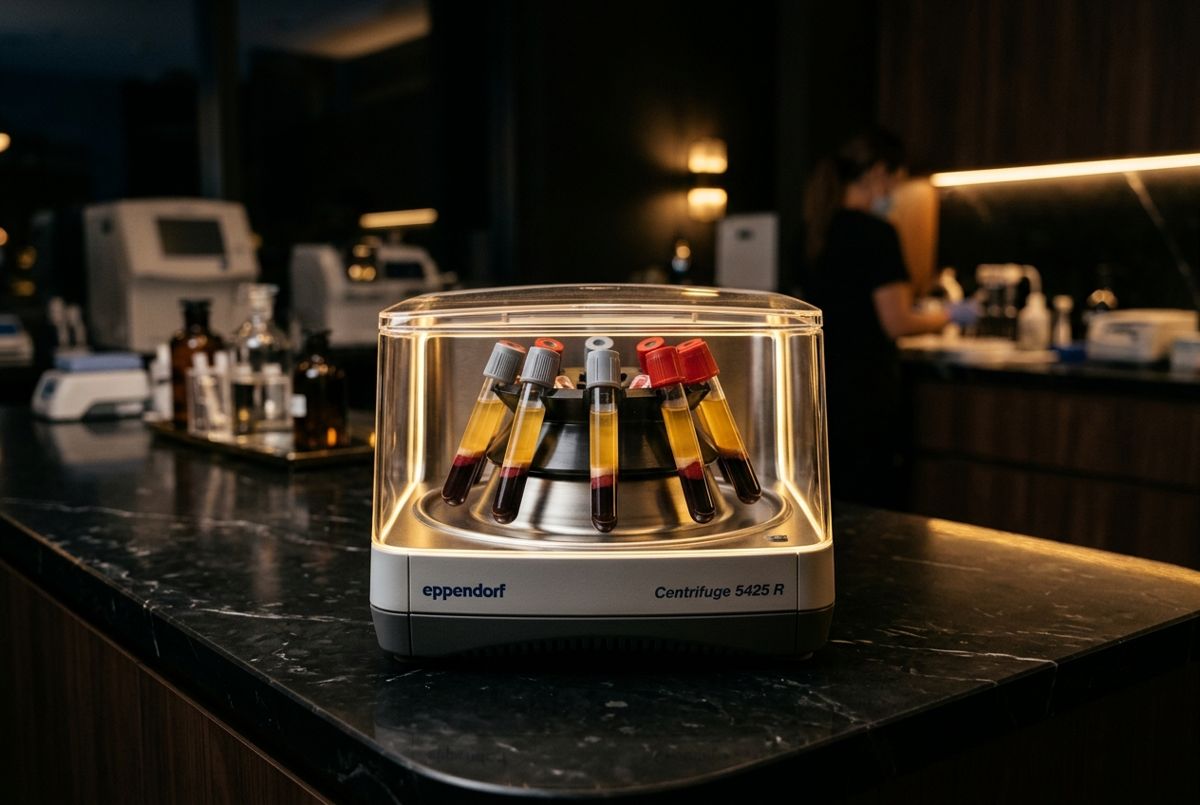
Platelet-Rich Plasma is exactly what it sounds like. Whole blood is spun in a centrifuge that separates red cells, white cells, platelets, and plasma by density. We isolate the plasma layer that is dense with platelets — typically 3 to 7 times the concentration in circulating blood — and discard the rest.
Platelets are usually thought of as clotting cells, but they are also packed with growth factors: PDGF, TGF-beta, VEGF, EGF, IGF-1 and more. When platelets are activated at an injury or injection site, they release those growth factors and recruit stem cells, stimulate collagen, build new blood vessels, and orchestrate the repair cascade. PRP simply puts a lot more of that signal in one place.
The Three Pillars of PRP at Zen
1. Hair Restoration
This is where most of our patients first meet PRP. Injected into the scalp, platelet growth factors extend the growth phase of hair follicles, increase blood supply to the follicle, and thicken miniaturized hairs. Studies show measurable increases in hair count and shaft thickness after a series. We use PRP as a standalone treatment for early thinning, as a booster around robotic hair transplant to improve graft survival, and in combination with exosomes and Sylfirm X for the scalp.
- Thickens existing hair and slows miniaturization
- Improves graft survival and speeds healing after transplant
- Drug-free option for patients who cannot or prefer not to use finasteride
- Typical protocol: 3–4 sessions, 4–6 weeks apart, then maintenance every 6–12 months
2. Skin Rejuvenation
Applied topically with microneedling or injected into fine lines, under-eye hollows, and areas of texture loss, PRP stimulates fibroblasts to produce new collagen and elastin. The improvement is gradual and natural — better texture, tone, and glow over 4 to 8 weeks rather than an overnight change. Paired with Sylfirm X radiofrequency microneedling, PRP delivers the growth factors directly into the channels the device creates.
3. Joint and Soft-Tissue Repair
Tendons and ligaments have notoriously poor blood supply, which is why they heal so slowly. PRP injected under ultrasound guidance into a tendinopathy, partial tear, or arthritic joint supplies the growth factors that blood flow cannot. Outcomes research in knee osteoarthritis, tennis elbow, plantar fasciitis, and rotator cuff tendinopathy consistently shows pain reduction and improved function that outlasts steroid injections — without the tissue-weakening effect of steroids.
What a Treatment Looks Like
A PRP visit takes about an hour. We draw 15–60 mL of blood, roughly the same as a standard lab panel. While it spins, we numb the treatment area with topical or local anesthetic. The concentrated PRP is then injected in a precise pattern — a few dozen tiny injections for the scalp, targeted placement for a joint. You can drive yourself home. Mild soreness or swelling for a day or two is normal; we ask you to avoid anti-inflammatory medications for a week so you do not blunt the very inflammatory healing signal we just created.
Why Not Every PRP Is Equal
Results depend on platelet concentration, how the sample is handled, and the skill of the injection. A low-grade kit that yields barely-above-baseline platelet counts will produce barely-above-baseline results. We use a medical-grade double-spin system, confirm concentration, and — for joints — place every injection under ultrasound so the PRP lands exactly where the pathology is.
Combining PRP With the Rest of Regenerative Medicine
PRP delivers the signal; the body still has to execute it. That is why we routinely pair PRP with hyperbaric oxygen (so the treated tissue has the oxygen to build), with BPC-157 or GHK-Cu peptides (to amplify and sustain the repair signal), and with proper nutrition and IV support. Patients who stack these see faster and more durable results than PRP alone.
If you are watching your hairline, your skin, or a joint that never quite healed, PRP is often the first thing I recommend — because it uses your own biology, and your own biology is remarkably good at repair once it gets the right instructions.